
Automatic Gate Installation
Gate Installation: Having a clear vision of the gate you desire can significantly reduce both design and installation time. Custom gates typically require a lead time of 10 weeks for construction.
Automatic Gate Opener: I highly recommend US Automatic products; you can explore various setups on their website. Among their offerings, the Patriot 1 Solar Gate Operator stands out as their most popular model, with an MSRP of approximately $2,685.
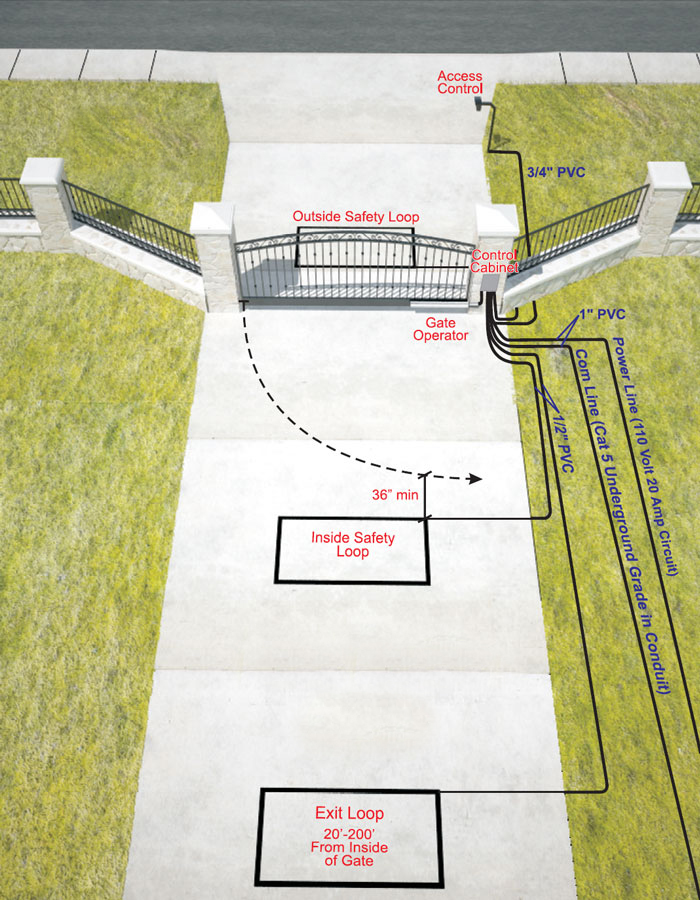
Driveway loops are an integral part of most automatic gate systems. They are used to command the gate to open or prevent it from closing on a vehicle in the path of the gate. They can also be used for peripheral activities such as turning on driveway lights or signaling a residence that a vehicle has arrived.
Gate loops have the following functions:
- Exit Loop – Typically placed 60 feet or more away from a gate, but can be placed as little as 4 feet away from the gate. When tripped, they cause the gate to open.
- Safety Loops (also called Reverse Loops) – Typically placed close to the gate (4 or 5 feet away) on the inside and outside. If tripped when gate is closing, will cause the gate to re-open. For instance, if a gate is closing and a car passes over a safety loop.
- Shadow Loops (also called Center Loops) – Used for large swinging gates when the arc of a gate is longer than a typical car. Placed under the swinging portion of the gate. The shadow loop acts like a safety loop but is deactivated when the gate begins to close to prevent the metal in the gate from tripping a re-open occurrence.
- Entry Loops – Placed on the outside of the gate, entry loops are used to command the gate to open in situations where security is not a concern. For instance, when a gate is only used as a barrier to keep deer out. Entry loops can also be used to turn on driveway lights or send a signal to a house that a car has arrived.
Loops can be installed using two types of loop – preform or saw cut.
Preform loops come with the wire already cut to length, twisted, and inside of flexible conduit or a protective sheath for the sensing portion of the loop. Preform loops are used for roads that are not paved or for roads prior to paving or concrete pours. A trench is dug 1″-6″ below the finish grade of the road in the case of asphalt paving with the loop inserted and then covered and run back to the gate operator. In the case of concrete, the loop is tied to the rebar structure before the pour.
Saw cut loops are used for existing paved roads.
A good rule of thumb for loop installation is that the read height of the loop (i.e. the distance off the ground that a vehicle will be detected) is about 2/3 the distance of the shortest leg of the loop. For a 5′ x 5′ loop, this will give a read height of 3-1/3 feet. For detecting high bed vehicles, one should increase the loop size, depending on the height of the typical vehicle. A 6′ x 8′ loop is adequate in many instances.
Adding loop turns, for a saw cut loop, will not increase loop sensitivity, but it will make the loop more stable so that false detects will be less likely, provided the rest of the installation of the loop was done properly.
What to Know Before Installing Access Control
Property owners in South Texas often ask about system durability and maintenance needs before committing to automated entry solutions.
How does wind affect automatic gate performance?
South Texas wind gusts place lateral stress on gate panels, so installations require cross-bracing and heavier-duty hinges than standard residential systems. Openers with wind load ratings prevent motor burnout during sustained high winds.
What happens if the power goes out?
Battery backup units maintain gate operation for 24 to 48 hours depending on usage frequency, while solar-charged systems continue functioning indefinitely as long as panels remain unobstructed. Manual release mechanisms allow you to disengage the motor and swing the gate by hand during extended outages.
How is the access code system programmed?
Control panels store multiple user codes that you assign and delete through the keypad interface or connected app, allowing temporary access for contractors or guests without distributing permanent remotes. Rolling code technology prevents signal interception by changing the transmission sequence after each use.
What maintenance does the system require?
Hinge points need periodic lubrication to prevent binding, and track channels for sliding gates require debris removal to avoid motor strain. Opener chain tension should be checked twice yearly to prevent slack that causes uneven movement.
When should I choose sliding versus swinging gates?
Sliding gates work better for driveways on slopes or properties with limited clearance in front of the gate line, while swinging gates require space for the arc but handle uneven ground more easily. JH Landworks evaluates your driveway layout and terrain to recommend the mechanism that fits your site conditions.
JH Landworks configures access control systems based on how many users need entry and what level of security your property requires. Request a consultation to review gate style options and control features that match your access management needs.